Running a Local Business in India Without a Shop
Ask most people in India what it means to grow a small business and you will get the same answer. Save up, take a shop, pay the deposit, put up a board. The shop is treated as the goal, and the cart as the stage before the goal.
The arithmetic does not really support that.
What a shop actually costs
A shop is not one expense. It is a deposit you cannot use for stock, rent every month whether you sell anything or not, electricity, and in most markets some form of maintenance. The rent is due in a slow week exactly as it is due in a good one.
That is the part people underestimate. Fixed costs remove your ability to have a bad month. A vendor with a cart who sells nothing on Tuesday has lost Tuesday. A shopkeeper who sells nothing on Tuesday has lost Tuesday and still owes rent for it.
Street vending has the opposite structure. Your costs move with your sales. Buy less at the mandi, spend less. There is no floor under your expenses that you have to clear before you earn anything.
So what is the shop really buying?
One thing, mostly: being findable.
A shop sits in a fixed place. People walk past it, remember where it is, and come back. The board tells them what you sell. The address makes you a place, not an event.
That is genuinely valuable, and for a long time there was no other way to buy it. If you wanted people to be able to find you reliably, you paid rent. The rent was the price of a permanent address.
What has changed
A cart can now have an address of a different kind. Your profile is a fixed point that people can find, follow and come back to, even though the cart itself moves.
The pieces that make this work are not complicated:
- Customers near your route can find you by category and location, in the same way they would look for a shop
- They get told when you are nearby, which a shop cannot do
- They can see what you are carrying today, which a board cannot do
- They can follow you, so finding you once means finding you every time
That last one is the important one. A shop earns repeat custom by staying in the same place. A cart earns it by being reachable. Both end up at the same destination, which is a customer who knows how to buy from you again. Only one of them requires a deposit.
The advantages a shop cannot copy
Once you stop treating the cart as a lesser version of a shop, some real advantages become visible.
You go to the demand. A shop waits for whoever walks past. If the footfall dries up, the shopkeeper can do very little about it. You can look at where interest is highest today and take the cart there. A bad location is a permanent problem for a shop and a Tuesday problem for you.
You reach people who cannot come to you. Elderly customers, families without a car, anyone with small children at home. For a good number of households, the vendor who comes to the gate is not a convenience but the main way vegetables enter the house.
Your overheads stay near zero. Which means your prices can stay competitive without cutting into what you earn. A shop has to price in rent. You do not.
Where the cart is genuinely weaker
Being honest about this matters more than the pitch.
You cannot hold much stock. You cannot offer credit easily, because the trust that comes from a fixed address is doing real work in a kirana shop and you do not have it in the same form. Bad weather removes your working day entirely. And there is no signboard doing quiet advertising for you all day while you sleep.
Some of that can be worked around. Reservations reduce the stock problem, because you carry against demand you already know about instead of guessing. Ratings and reviews build the trust that an address used to provide. Weather stays a real problem, and no app changes it.
How to actually build this up
A few things that consistently separate vendors who grow from vendors who stay flat.
Be predictable before you try to be big. Same lanes, same times, most days. Households build routines around vendors they can rely on, and a routine is worth more than any single day's sales.
Specialise a little. Being the person who reliably has good fruit is a stronger position than carrying a bit of everything. It gives people a reason to look for you specifically.
Track what came back unsold. Not in a register if you would rather not, but at least in your head. The gap between what you bought and what you sold is where most of the lost money in this trade is sitting.
Let people find you between visits. This is the piece that is genuinely new. A customer who thought of you on a day you were not on their street used to be a sale that evaporated. Now they can see whether you are out, ask you to come, or reserve for next time.
The credit question
One thing a shop does that a cart struggles to copy is udhaar.
The kirana shop that lets a household run a monthly account is buying loyalty with it. That family is not going anywhere, because the relationship has money in it. It works because the shop is not going anywhere either — the address is the collateral.
A vendor extending credit has a harder version of the same problem. You are on that lane most days, but not every day, and a household that decides to stop paying is not easy to chase.
Most vendors handle this by keeping credit small and personal, limited to households they have known for years. That is sensible and there is no clever way around it. What has changed slightly is that a profile with a history and a rating gives both sides something the pure cash relationship did not have, and that is worth something on the trust side even if it does not solve credit outright.
When a shop actually is the right answer
None of this means the shop is always wrong. It is right in specific cases, and it helps to know which ones.
If your goods need storage or refrigeration, you need premises. If you are selling something people research and compare before buying, rather than picking up in passing, a fixed place they can return to matters more. If your stock is valuable enough that hauling it around is a security problem, a shop solves that.
The mistake is not choosing a shop. The mistake is choosing one by default, because it feels like the next step, without checking whether the rent is buying you anything you cannot now get otherwise.
For most vendors selling fresh produce, household goods or daily-use items on a route, the honest answer is that it is not.
The point
The cart was never a step on the way to a shop. It is a different business with different economics, and on the cost side those economics were always better. What it lacked was a way to be found on purpose rather than by luck.
That was worth paying rent for, once. It is not anymore.
If you sell on a cart, a cycle or on foot, you can see what is available for vendors and register free. The hawker guide covers the practical side of the trade, and the features page lists every tool in full.
Related Readingसंबंधित लेख
How to Get More Customers on Your Daily Route
A practical guide for sabzi wale, fruit sellers, cloth vendors and hawkers on covering your route more profitably, cutting down unsold stock, and turning one-time buyers into regulars.
Read More →और पढ़ें →Never Miss Your Sabzi Wala Again: Nine Things Most People Do Not Know the App Can Do
You already know FeriBazaar tells you when a vendor is nearby. The features people actually find most useful are the ones nobody mentions: family alerts, reservations, scheduled visits and colony requests.
Read More →और पढ़ें →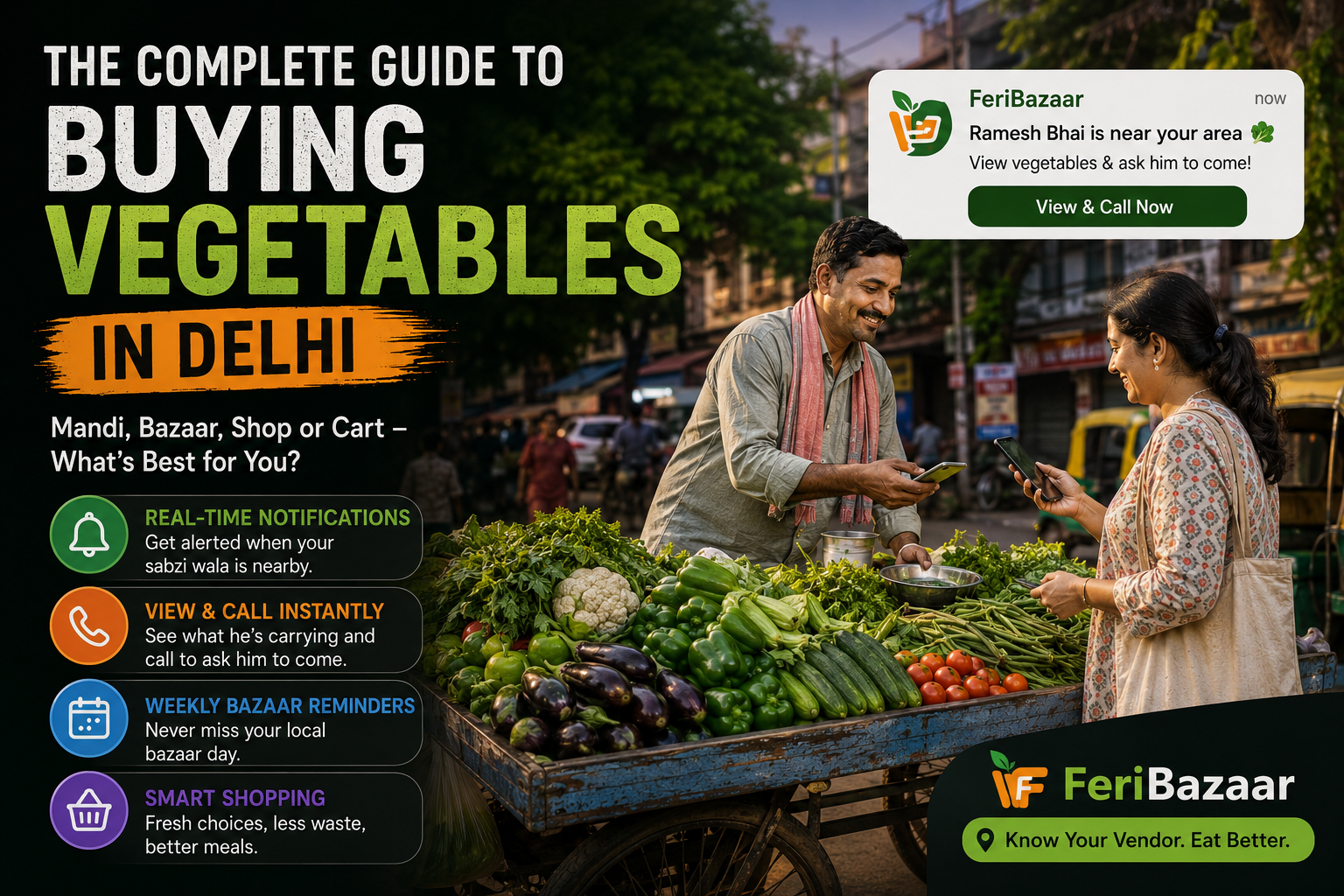
Buying Fresh Vegetables in Delhi: A Practical Guide
Delhi gives you four different ways to buy vegetables, and most households use only one. What the mandis, the weekly bazaars, the local shops and the carts are each actually good for.
Read More →और पढ़ें →