How to Get More Customers on Your Daily Route
Most street vendors do not lose sales because their vegetables are poor or their prices are wrong. They lose sales because the people who wanted to buy simply did not know they were on the street.
You push the cart past a building. On the third floor, someone is making a shopping list and thinking about tomatoes. She does not hear you. You move on. That sale never happened, and neither of you ever knew about it.
This is the gap FeriBazaar is built to close. What follows is not theory. It is the practical version of how to use it on a working route.
Start with the route you already have
There is a temptation, when you try something new, to change everything at once. Do the opposite. Your existing route is worth more than you think. You already know which lanes have buyers, which gates the guards will let you stand near, which streets go quiet after ten. That knowledge took years.
Keep all of it. What changes is only this: the households on that route now find out you are coming before you get there.
When you tap Start Route in the app, your location updates as you move. Customers who have followed you get an alert when you come within their chosen distance, which they set themselves at 100 metres, 300 metres or 500 metres. Someone who set 500 metres gets roughly five to eight minutes of warning. That is enough time to find a purse and come downstairs.
Those minutes are the whole point. A customer who knows you are coming is a customer who is ready. A customer who hears you shouting from the road has to decide, find money, and get down before you leave. Most of them do not manage it.
Put up your stock before you leave home
This is the step vendors skip most often, and it is the one that pays best.
Before you start the route, list what you are carrying today with prices. If you cannot type, or typing is slow, speak instead. Say it the way you would say it to a customer at the gate: "Aaj tamatar pachees rupaye kilo, palak bees rupaye, dhaniya das ka." The app turns that into a proper listing with prices.
Two things follow from this.
The first is that customers decide before you arrive. They have already seen the price and already know they want a kilo of tomatoes. When you reach the gate, the transaction takes forty seconds instead of four minutes. On a long route those saved minutes add up to extra lanes covered before your stock or the day runs out.
The second is that people buy things they were not planning to buy. Somebody opens the app for onions, sees you have fresh methi, and adds it. That does not happen when your cart is a mystery until it arrives.
Pay attention to who is asking for you
Customers can tap Interested on your profile, and they can send a request asking you to come to their colony. When several homes in the same colony request you, those requests group together into one community request.
Treat these as instructions, not compliments. A community request tells you that a particular lane has multiple people waiting on a particular day. That is the single most useful piece of information a vendor can have, because the cost of a route is not the selling. It is the pushing, the fuel, the hours. Ten buyers on one street is a completely different day from ten buyers spread across four kilometres.
The demand heatmap does the same job in a wider view. It shows which areas near you have interest right now. Use it on slow days, when your usual lanes are not producing and you would otherwise be guessing.
Carry less of what does not sell
Unsold stock is the quiet killer in this trade. Vegetables that come back on the cart in the evening are not just a lost sale, they are money you already spent at the mandi.
Reservations help here in a way that is easy to underestimate. When customers reserve items before you arrive, you start the day knowing part of your stock is already spoken for. Over a few weeks a pattern shows up: which items get reserved, which get ignored, which sell only on certain days.
Buy to that pattern. Most vendors buy on habit and memory. Buying on what people actually reserved last week is a better guess, and better guesses on the buying side compound faster than anything you do on the selling side.
Be findable at the same time every day
Households run on routine. The cook needs vegetables before she starts lunch. The office-goer wants fruit before eight. If you are on a lane at nine on Monday and eleven on Tuesday, people stop planning around you, because they cannot.
Share your route in the morning so customers see roughly when you will reach their area. Then hold to it. A vendor who is predictable becomes part of the household routine, and once you are part of the routine you are no longer competing on price every single day.
This is also the honest answer to why some vendors build a following and others do not. It is rarely the produce. It is almost always reliability.
Give people a reason to follow you
Following a vendor is a small decision for a customer, but it changes everything about how often they buy from you. Followers get alerts. Followers get your broadcasts.
So ask. When someone buys from you and seems happy, tell them plainly: follow me on the app and you will know when I am coming. Most people say yes, because it solves a problem they actually have.
Then use the broadcast carefully. It goes to everyone who followed you, which makes it useful and easy to waste. Send it when the mangoes are good, when you have a clearance price in the evening, when you will not be on the route tomorrow. Do not send it daily. People mute what they cannot use.
What the first two weeks actually look like
Vendors who quit usually quit in week one, and it is worth knowing why so you do not.
On day one you have no followers. Nobody near you has the app open waiting for a sabzi wala. You go live, you finish your route, and nothing measurably different happens. This is normal and it is not a sign that it does not work.
The build is slow at the start because it depends on households near your route joining. That happens through you telling customers at the gate, and through neighbours telling each other. The first few followers are the hardest ones. After that it moves faster, because a customer who is happy tends to mention it to the family next door.
So the realistic expectation for the first fortnight is a handful of followers and one or two alerts that turn into sales. If you judge it on week one you will conclude it is useless. Judge it on week six.
The one thing that speeds this up more than anything else is asking. Every customer who buys and looks satisfied is somebody who will probably follow you if you mention it. Most vendors feel awkward asking and so never do, and then wonder why their follower count is not moving.
Ratings are worth taking seriously
Customers can rate and review you. In a trade built almost entirely on personal reputation, that is not a small thing, and it cuts both ways.
A good rating is doing work for you with people who have never met you. Somebody browsing for a fruit seller in an unfamiliar area has no way to judge between two names on a screen except by what other buyers said.
The things that produce good ratings are unglamorous. Correct weight. The price you listed and not a rupee more when you get there. Not putting the soft ones underneath the good ones. Turning up roughly when you said you would.
None of that is new advice. What is new is that it now accumulates in public instead of staying inside one lane's word of mouth.
What this will not do
It is worth being straight about the limits.
The app does not bring customers to an area where nobody wants what you sell. It does not fix produce that is not fresh. It will not help much in the first week, when very few people near you have followed anyone yet. Early on, the number of alerts going out is small, and the honest expectation is a slow build rather than a sudden change.
What it does is remove one specific problem: the buyer who wanted your vegetables and never knew you were outside. That problem is worth removing. It is not the only problem in this business.
Getting started
Registration is free and takes about five minutes. If apps are not your thing, that is fine and fairly common. Somebody calls you, you answer, and it gets set up together over roughly twenty minutes, in Hindi.
You can register as a vendor here. If you want to see the whole flow first, from a customer's side as well as yours, how it works lays out all six steps, and the features page covers every tool in detail.
Related Readingसंबंधित लेख
Never Miss Your Sabzi Wala Again: Nine Things Most People Do Not Know the App Can Do
You already know FeriBazaar tells you when a vendor is nearby. The features people actually find most useful are the ones nobody mentions: family alerts, reservations, scheduled visits and colony requests.
Read More →और पढ़ें →Running a Local Business in India Without a Shop
Rent is the single biggest fixed cost in retail, and street vendors have never paid it. What has changed is that a cart can now be found the way a shop is found.
Read More →और पढ़ें →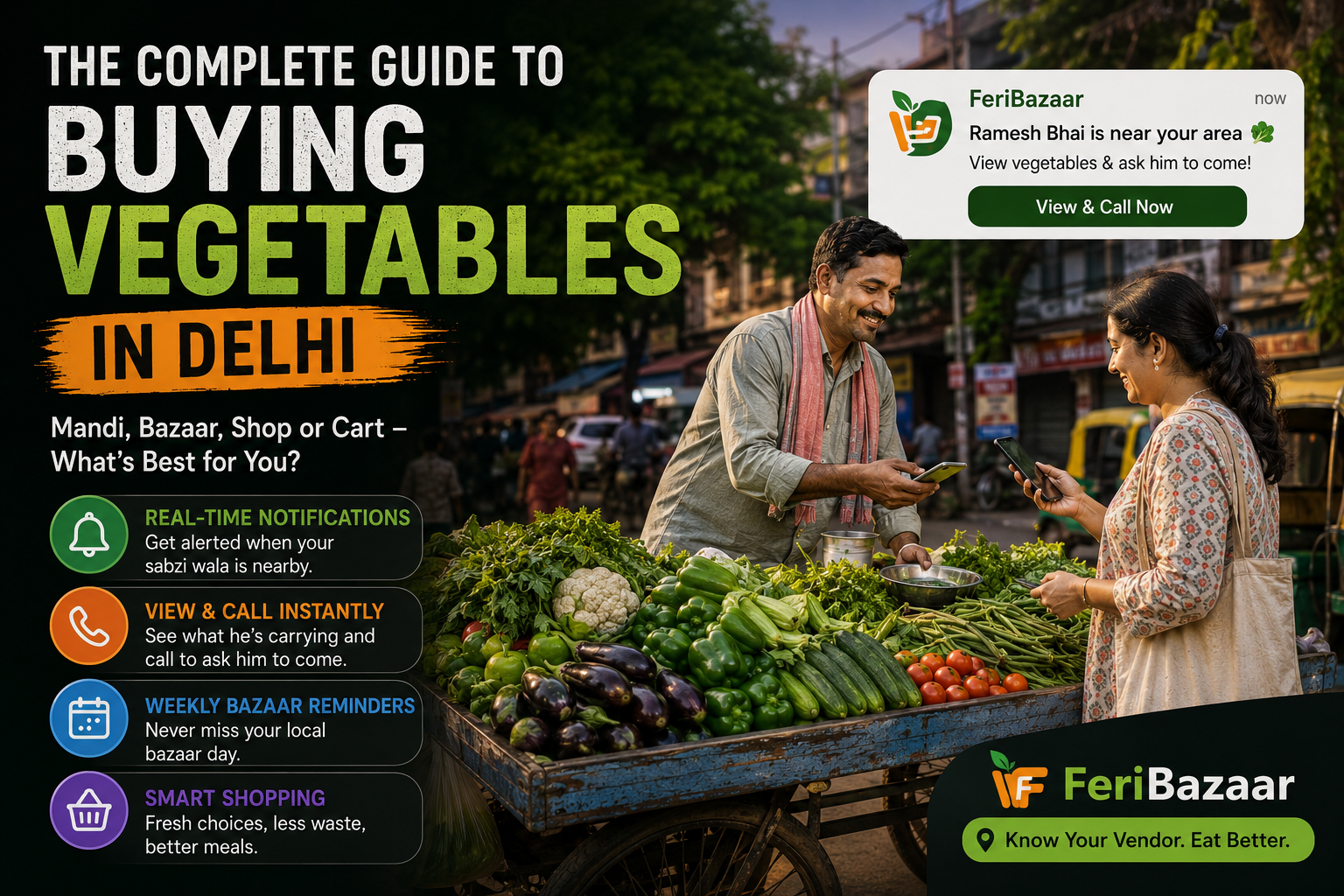
Buying Fresh Vegetables in Delhi: A Practical Guide
Delhi gives you four different ways to buy vegetables, and most households use only one. What the mandis, the weekly bazaars, the local shops and the carts are each actually good for.
Read More →और पढ़ें →